





Shipping packaging machinery internationally requires more than arranging a freight booking. Before dispatch, a buyer should confirm exactly what equipment will be shipped, verify the final packed dimensions and weights, review protection and handling requirements, establish who is responsible for each transport stage, and obtain the records needed to approve shipment.
The central decision is whether the actual packed machinery is ready for the agreed transport route, not simply whether the machine has finished production or passed a factory acceptance test (FAT).
For buyers of automatic case-making machines, inner-laminating equipment, collapsible-box production machinery and related systems, this distinction is important. A machine’s operating configuration is not necessarily identical to its shipping configuration. Packaging, separated components, accessories and loading arrangements can all change the information needed by the freight forwarder and receiving factory.
The checklist below explains what buyers should request, what they should verify, and which unresolved issues should be addressed before authorizing dispatch.
Identify the Machine, Shipment Units, and Missing Shipping Data
The first packing decision is not which crate to use. It is identifying the equipment and components that the shipment must contain.
A packaging production system may include a primary machine, separate process modules, electrical equipment, transfer mechanisms and accessories. Depending on the selected configuration and approved transportation arrangement, some parts may be shipped separately. The actual breakdown must be confirmed from the manufacturer’s project documents rather than inferred from catalogue photographs or general equipment descriptions.
For example, HORDA’s machinery catalogue includes automatic case-making machines, case-making and inner-laminating lines, collapsible-box equipment and frame-stretching machines. These product categories do not establish how a particular order will be dismantled, packed or transported.
Before packing begins, the buyer should obtain a shipment identity register that connects the approved order to the physical items being prepared.
The register should identify:
- The exact machine model, configuration and order reference.
- Each machine, process module or separate shipping unit.
- Detachable components, tooling, change parts and accessories included in the agreed supply.
- The corresponding package or crate identification for each item.
- Available serial numbers or other agreed traceability identifiers.
- The current revision of the packing list or shipment inventory.
The list should be sufficiently precise to allow someone who did not witness packing to reconcile the delivered packages against the agreed supply.
Distinguish Machine Dimensions from Shipping Dimensions
An assembled machine’s published dimensions and weight are not the same as its final packing dimensions and gross shipping weight.
Packing structures, protective materials, skids and separately secured items can change the package envelope and mass. Conversely, approved separation of a machine into transport units may change the dimensions and handling requirements of individual packages.
The buyer therefore needs the final length, width, height and gross weight of each packed unit, together with handling information relevant to the selected transport method.
If final packing data is unavailable when freight is first quoted, the quotation should identify that uncertainty. A preliminary shipping estimate should not be treated as proof that the completed packages are suitable for the proposed transport equipment.
The result of this first check should be an agreed shipment inventory with clearly identified gaps. Those gaps need to be resolved before the final packing and loading arrangements are approved.
Match the Export Packing Plan to the Shipping Route and Handling Risks
An export package should be evaluated against the conditions the machinery may encounter between the shipping origin and the receiving site.
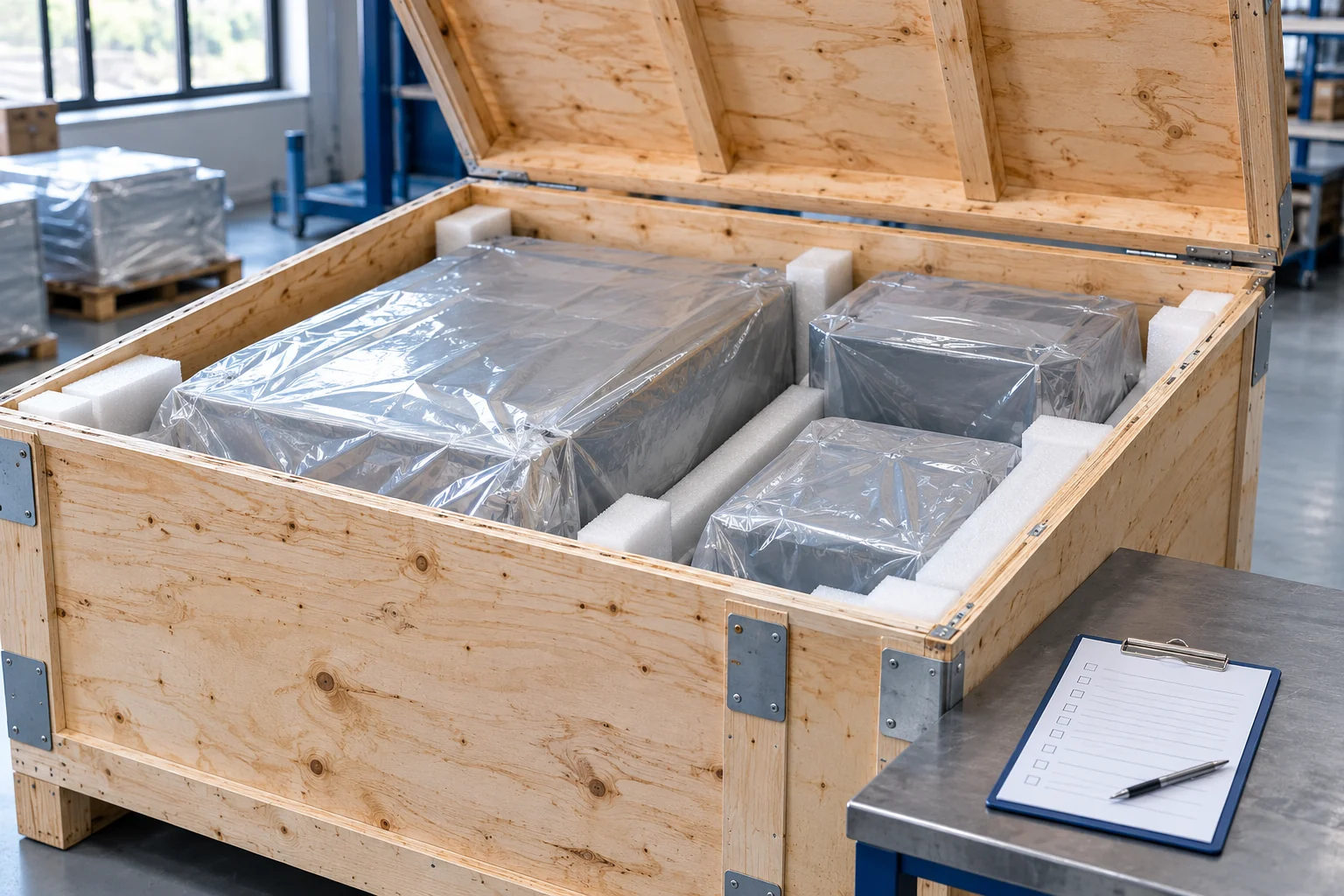
The same machine can face different transport exposures depending on the route, shipping mode, number of handling operations, storage conditions and duration of transit. This is why a generic statement such as “export wooden packing” is not, by itself, a complete technical packing specification.
Transport Route and Exposure Conditions
A shipment may move through loading areas, terminals, warehouses and several transport vehicles before reaching the destination. Each handover can introduce different handling and environmental conditions.
For machinery buyers, the key exposures to consider are mechanical movement, handling impacts, moisture and condensation, and periods of storage or waiting between transport stages.
Mechanical movement and moisture exposure should be evaluated separately because they can damage equipment through different mechanisms.
For instance, restraint intended to limit cargo movement does not necessarily protect a sensitive component against condensation. Equally, wrapping that reduces moisture exposure does not demonstrate that a heavy machine is adequately supported or secured against transport forces.
International cargo-packing guidance, including the IMO/ILO/UNECE Code of Practice for Packing of Cargo Transport Units (CTU Code), addresses the importance of cargo distribution, securing and transport conditions. The 2014 CTU Code is non-mandatory guidance; applicable laws, carrier requirements and project specifications must be considered separately.
Protection Requirements and Failure Modes
Moisture protection should account for how water or condensation could reach vulnerable surfaces and components. Moisture may originate from ambient conditions, damp packing materials or humidity already enclosed within the packaging.
Consequently, adding a barrier or desiccant is not automatically sufficient. The suitability of the protection depends on the materials, enclosure arrangement, expected exposure and the equipment being protected.
Mechanical protection follows another decision path. The package must be designed so that the machine and its components are adequately supported and restrained without imposing inappropriate forces on sensitive parts.
A buyer can use a simple risk-to-verification comparison:
| Transport exposure | Potential consequence | Packing evidence to request |
|---|---|---|
| Moisture or condensation | Corrosion or moisture-related damage to vulnerable components | Approved preservation approach and evidence of its implementation |
| Movement during transport | Shifting, contact damage or instability | Blocking, restraint and loading-plan information |
| Handling impacts | Damage to machine surfaces, protruding components or assemblies | Approved handling arrangements and protection of exposed areas |
| Extended storage or transfer | Continued exposure outside the intended preservation conditions | Storage assumptions and packaging limitations |
| Concentrated package weight | Excessive loading on the support structure or transport-unit floor | Packed weight, contact footprint and load-distribution review |
These are possible risk mechanisms, not predictions that a particular machine will be damaged. The final packing design should address the actual configuration and shipment conditions.
The practical buyer question is therefore not simply, “Will the machine be packed?” It is, “Which transport risks does the proposed packing address, and what evidence supports that conclusion?”
Verify Machine Protection, Export Crating, and Component Restraint
Once the transport risks are understood, the buyer can review whether the proposed packing arrangement addresses them.
A crate, skid or other transport package serves several possible functions: supporting the equipment, providing handling interfaces, protecting components and allowing the cargo to be secured. The appropriate design depends on the machine and the approved transport plan.
Buyers should ask the responsible packing party to identify the packaging arrangement and any relevant limitations. Where the project requires them, packing drawings or written specifications should show how the main equipment and separately packed components will be supported and protected.
Protect the Machine Without Creating New Damage Risks
Sensitive parts need to be considered according to their actual function and construction.
Depending on the selected equipment, these could include electrical assemblies, exposed mechanisms, sensors, guards, finished surfaces or detachable components. Their presence and handling requirements must be confirmed for the exact configuration.
For example, protecting an exposed mechanism may involve preventing unintended movement or contact with packing materials. However, a restraint must not be attached to an unsuitable location merely because that location is convenient.
The correct restraint and protection arrangement should be approved by the responsible manufacturer or qualified packing engineer using the applicable equipment documentation.
Loose accessories create a related identification and containment problem. If tooling or removed parts are packed separately, their location should be traceable to the shipment inventory. A package may arrive without obvious external damage and still have missing or unidentified contents if that link is not maintained.
Check Wood Packaging Requirements Separately
When solid-wood crates, pallets or dunnage are used, the buyer should establish whether the applicable importing-country requirements bring those materials within the scope of ISPM 15.
ISPM 15 addresses phytosanitary measures for regulated wood packaging material. Packaging made entirely from processed wood such as plywood is generally outside its scope; however, a crate that also contains solid-wood skids, blocks or bracing still requires those raw-wood components to be assessed against the applicable requirements. The presence of plywood does not exempt a mixed-material crate as a whole.
Where treatment and marking requirements apply, buyers should request appropriate evidence and confirm that relevant package markings are present and identifiable.
An ISPM 15 mark is not proof that a crate is structurally adequate, waterproof or capable of protecting the machine against transport damage. Phytosanitary compliance and physical packing performance are separate verification tasks.
This distinction also applies when a freight forwarder says that a wooden crate is suitable for export. The buyer still needs to understand what suitability means for the specific shipment.
The packing review should conclude with a record of the agreed protection method, package identification and any deviations requiring acceptance before loading.
Check Packed Dimensions, Lifting Points, and Cargo Securing Before Loading
A packing design cannot be approved independently of how the finished package will be handled and transported.
Once the machinery is packed, its dimensions, gross mass, support footprint and mass distribution become the relevant inputs for transport planning. The transport equipment and loading method must be assessed against those final characteristics.
Final Packed Weight and Envelope
Three different measurements should not be confused:
- Machine net mass: the mass of the machine or identified module without its transport packaging.
- Packed-unit gross mass: the mass of an individual packed unit, including the equipment and its packaging.
- Verified gross mass (VGM): the verified mass of a packed freight container for applicable containerized maritime transport under SOLAS requirements.
These values serve different purposes. A machine’s catalogue weight cannot automatically replace the gross weight of its packed crate, and the combined weight of separate packages is not by itself a verified container gross mass. For applicable sea shipments, VGM may be established by weighing the packed container or by combining the cargo, packing and securing-material masses with the container’s tare mass under an approved method. The named shipper’s responsibility for providing VGM must be assigned before the carrier’s submission deadline.
The final package envelope should be checked against the available transport space, loading access and any dimensional limitations along the route.
An important engineering distinction is that geometric fit does not establish safe loading.
A package might fit within a container’s internal dimensions while still presenting an unacceptable load-distribution problem or requiring handling equipment that has not been approved for its weight and geometry.
Heavy machinery can also create concentrated loads through a relatively small support footprint. Load distribution must therefore be reviewed using the actual contact arrangement, not only the total package weight.
Handling and Securing Interface
Before loading, the responsible parties need to confirm how each package can be lifted or otherwise handled, where the load will be supported, and how cargo movement will be controlled.
Lifting points should be based on approved equipment and packing documentation. A visible structural member, convenient opening or apparent lifting eye should not be assumed suitable without confirmation of its intended purpose and rating.
The centre of gravity may also matter to the handling and securing plan, especially when the package is tall, asymmetrical or otherwise susceptible to instability. Its relevant location should come from approved data or a competent engineering assessment.
Cargo securing must account for the transport arrangement and loads that may occur during the journey. The CTU Code provides general guidance on load distribution and securing, but it does not approve a particular machine’s lashing configuration.
Buyers should therefore seek confirmation that the loading and securing arrangement has been reviewed by the responsible, competent party.
This review should connect four elements: the final package data, authorized handling interfaces, selected transport equipment and approved restraint arrangement.
If any of these elements remains unknown, simply having a crate ready at the factory does not complete the transport-readiness assessment.
Detailed lifting operations, lashing calculations and on-site rigging must follow applicable regulations, approved plans and qualified personnel’s instructions. A buyer checklist is not a substitute for those engineering procedures.
Confirm Shipping Documents and Who Is Responsible for Each Handoff
Physical packing and commercial shipping arrangements need to describe the same shipment.
The buyer should verify that the purchase agreement identifies who is responsible for packing, arranging transportation, loading, insurance where applicable, export/import formalities, delivery and receiving-side activities.
Incoterms 2020 provides internationally recognized rules for allocating certain delivery obligations, costs and risks. However, the chosen rule must be considered together with its named place and the actual sales contract.
Incoterms rules do not replace the complete sales agreement, determine the machine’s technical specifications or automatically resolve every insurance and unloading question.
For this reason, responsibility should be confirmed in writing rather than inferred from who booked the freight.
Match the Documents to the Physical Packages
Common international shipment records include a commercial invoice, packing list and the appropriate transport document, such as a bill of lading or air waybill depending on the mode of transport. Additional documents may be required according to the destination, goods, customs treatment and transaction.
The buyer should verify that the relevant records describe the same shipment. Some transport documents will only be available in final form after the relevant carrier handoff. Before dispatch, check the commercial invoice, final packing list and available shipping instructions; assign responsibility for checking the final bill of lading or air waybill against the shipment record once it is issued.
The packing list is particularly important because it connects the machine and accessory inventory to the actual numbered packages. Discrepancies in package counts, identifications, descriptions, weights or dimensions can create avoidable problems during transportation and receipt.
The final paperwork review should address three questions:
- Do the commercial and transport documents identify the agreed equipment and shipment correctly?
- Can every package be connected to the detailed packing inventory?
- Are the documents required at this stage ready, and is someone assigned to reconcile any later-issued transport documents?
Where wood-packaging compliance evidence, inspection certificates, permits or other documents are applicable, they should be included in the relevant document review. They should not be represented as universally required for every international machinery shipment.
The agreed responsibility matrix should also identify who will respond if the cargo is delayed, damaged or found incomplete, and how any insurance or contractual notification procedures apply.
Use a Pre-Shipment Packing and Shipping Release Checklist
The purpose of a pre-shipment checklist is to make the dispatch decision reviewable. It should link each material risk to evidence, a responsible party and an explicit disposition.
This is especially useful when the person authorizing shipment is not the person who designed the package or supervised loading.
The following buyer release matrix is a recommended procurement tool. It is not a claim about HORDA’s standard packing procedures and is not a universal regulatory form. The required evidence, reviewer and acceptance criteria should be agreed for the actual order.
Buyer Pre-Shipment Release Matrix
| Verification item | Risk if unresolved | Evidence to review | Responsibility to confirm | Release decision |
|---|---|---|---|---|
| Machine and accessory inventory | Missing or incorrectly identified equipment | Approved order/configuration and final package inventory | Supplier, packing party and buyer | Hold if material items cannot be reconciled |
| Final packed dimensions and weights | Incorrect freight arrangement or handling assumptions | Packed-unit measurement and weight records | Packing party and freight/logistics planner | Hold pending verified figures where required for planning |
| Protection and component restraint | Movement, moisture or contact damage | Approved packing specification and completion evidence | Packing party and relevant technical approver | Resolve missing or inconsistent protection evidence |
| Regulated wood packaging | Possible destination compliance problems | Material identification and applicable treatment/marking evidence | Packing party, exporter/importer as assigned | Confirm applicability and required compliance evidence |
| Handling and loading arrangement | Unsafe handling, unstable cargo or load damage | Approved lifting, loading and securing information | Qualified loading/transport parties | Do not authorize an unapproved critical handling plan |
| Shipping documentation | Clearance delays or shipment identity discrepancies | Commercial invoice, final packing list, shipping instructions and later-issued transport documents when available | Assigned exporter, shipping agent and buyer | Correct material inconsistencies before dispatch |
| Freight, insurance and delivery responsibility | Unclear obligations or unmanaged handoffs | Purchase agreement, trade term, named place and insurance details where applicable | Contracting parties | Resolve unassigned material responsibilities |
| Packing completion and exceptions | Inability to establish shipment condition or outstanding defects | Agreed inspection evidence, package IDs and exception log | Assigned inspector, packing party and buyer | Release only after required exceptions are closed or formally accepted |
A useful matrix records not only a pass or fail, but also the actual reference used to reach the decision. Agree on the evidence needed at each handoff: before a crate is closed, identify and record the protected equipment and accessories; after packing, verify package marks, dimensions and gross weights; at loading, obtain the agreed handling and cargo-securing confirmation. Where photographs are specified, they should show the relevant stage rather than only the exterior of a finished crate.
Where a check is not applicable, the reviewer should state why. Where the evidence is incomplete, the record should identify what remains outstanding and who has authority to resolve it.
The table should also distinguish technical approval from contractual acceptance. A freight quotation, packing photograph or inspection report can contribute evidence without automatically authorizing shipment.
Common Packing and Shipping Mistakes to Catch
Several recurring types of error follow directly from weaknesses in the evidence chain:
- Using published machine dimensions as final crate dimensions.
- Confusing machine net weight with packed-unit gross weight.
- Assuming a wooden crate is acceptable without checking protection needs or applicable wood-packaging rules.
- Focusing on container space while overlooking load distribution or approved handling.
- Leaving tooling or detachable accessories unlinked to package identifiers.
- Assuming that an agreed trade term automatically settles every insurance, unloading and inspection responsibility.
- Authorizing shipment while critical packing records or documentation discrepancies remain unresolved.
These mistakes share a common cause: one party assumes that another party has already verified a condition that was never expressly assigned or documented.
A stronger release procedure makes those assumptions visible.
For an order-specific inspection plan, the buyer and relevant parties should define in advance which evidence is essential, who can approve deviations, and which issues prevent dispatch.
A successful production FAT can establish the agreed machine-performance acceptance outcome, but it does not automatically verify the later packing, loading or shipping configuration. Any packing-related FAT or pre-dispatch acceptance criteria must be expressly specified and evidenced.
The resulting release decision should be straightforward: authorize shipment when the agreed critical checks are supported and material exceptions are resolved; otherwise, hold the affected release decision until the necessary evidence or authorization is obtained.
Prepare the Receiving Team to Reconcile Shipment Condition and Contents
The value of pre-shipment records continues after the cargo leaves the origin.
The receiving team should have access to the agreed package inventory, identification references, relevant handling information and the records needed to compare the delivered shipment with its documented dispatch condition.
On arrival, authorized personnel can reconcile visible package identifiers and record apparent external damage or discrepancies using the applicable receiving and transport procedures. If problems are identified, the buyer should preserve relevant evidence and follow the contract, carrier and insurer notification requirements.
This receiving review does not replace safe unloading. Crate opening, heavy-equipment handling, positioning and installation require the appropriate site preparation, approved procedures and qualified personnel.
The practical goal is continuity: the receiving team should not need to reconstruct the shipment’s contents, packing assumptions and handoff responsibilities from incomplete correspondence after the equipment has already arrived.
For buyers evaluating HORDA-manufactured equipment presented through Raymon Machinery, shipment planning should begin with the exact machine configuration and destination requirements. When preparing a quotation inquiry, provide the proposed machine or production-line scope, destination, expected transport arrangement and any required packing or documentation conditions.
Raymon Machinery can be used as an equipment inquiry and quotation channel. The actual packing scope, shipping services, contractual responsibilities and documentary deliverables must be confirmed in the applicable written quotation or order.
The final buyer checklist is not simply whether machinery has been packed and dispatched. It is whether the equipment, packaging, transport plan, documents and responsible parties have been reconciled sufficiently for an informed shipping-release decision.