
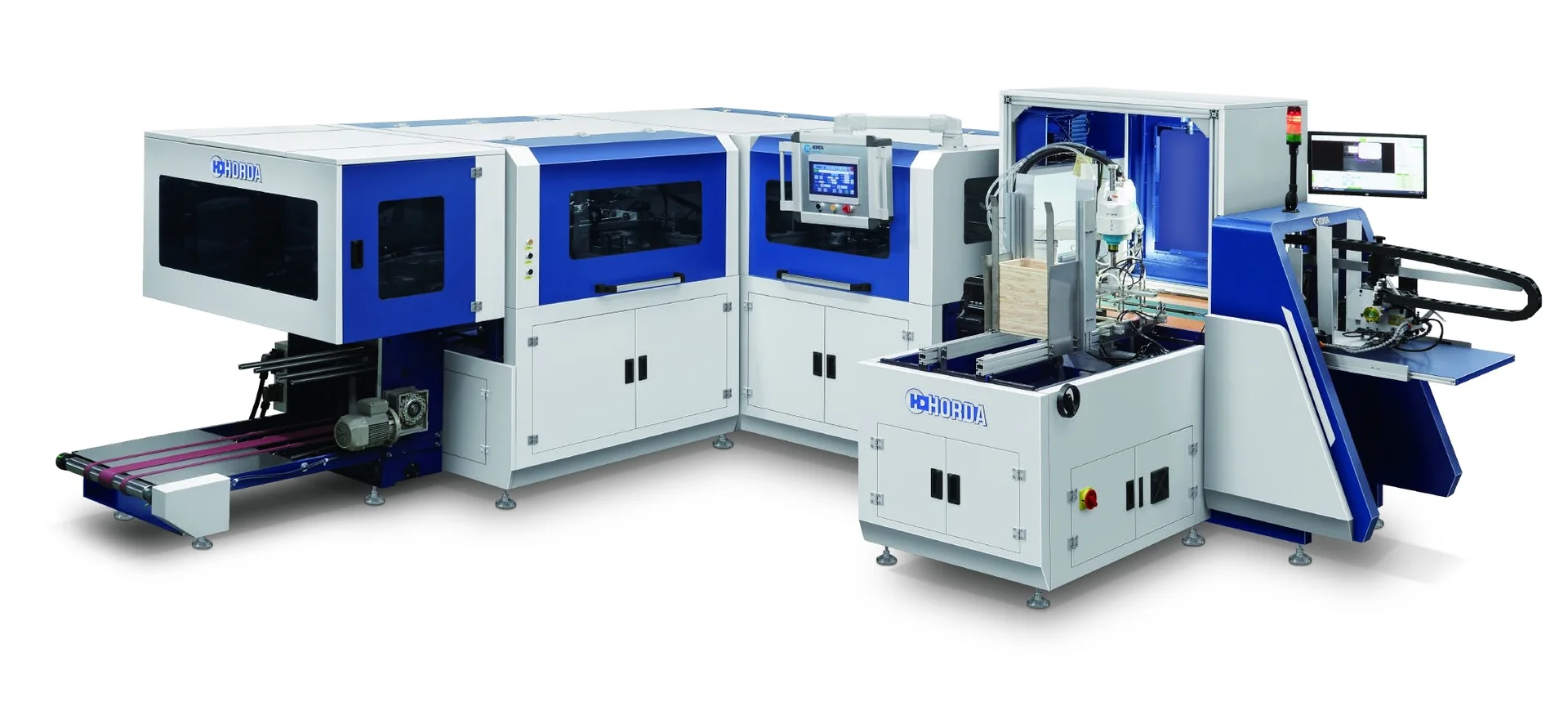
For a rigid ring box, greyboard thickness affects structural stiffness and dimensional fit, while cover paper grammage describes paper mass per unit area, but it does not by itself tell you how well the sheet will fold, feed, or bond. Corner appearance and wrapping quality also depend on paper caliper, fiber structure, grain direction, coating, adhesive, and machine settings. Neither specification alone establishes machine compatibility. A workable material combination must also suit the box construction, adhesive, surface finish, flat component dimensions, and the operations performed by each machine.
The safest starting point is to select a greyboard that supports the ring and its insert without unnecessary bulk, then choose a covering material that can wrap the required edges and corners without cracking, lifting, or wrinkling. Finally, test the complete material combination on the proposed production equipment. This matters particularly for small ring boxes: a material may be suitable for a larger rigid gift box yet cause feeding, alignment, or corner-folding problems in a compact format.
Greyboard Thickness vs. Cover Paper Grammage: What Is the Difference?
A conventional rigid ring box contains several materials with different functions. Greyboard provides the structural core. Cover paper creates the visible exterior. Inner lining covers exposed internal surfaces, while a foam, fabric-covered, or molded insert holds the ring in position. These components may require different converting and assembly operations.
The two main paper-based specifications should not be confused:
- Greyboard thickness, measured in millimeters (mm): The physical thickness of the structural board. It affects panel stiffness, wall thickness, corner geometry, internal clearance, cutting, and the board-handling capability required from production equipment.
- Cover paper grammage, measured in grams per square meter (g/m² or gsm): The mass of one square meter of paper. It helps identify the paper grade but does not directly specify paper thickness, flexibility, coating behavior, or resistance to cracking during folding.
For example, a 150 gsm uncoated paper and a 150 gsm laminated printed paper do not necessarily behave the same way at a wrapped corner. The laminated sheet includes another material layer, and its folding and bonding performance depends on the complete construction. Equally, two greyboards with the same nominal thickness can differ in density, stiffness, moisture condition, and cutting quality.
ISO 534:2011 specifies methods for measuring paper and board thickness (including single-sheet thickness), while ISO 536:2019 specifies determination of grammage. These are separate material properties and should remain separate fields in procurement specifications and equipment trials. Neither standard, by itself, certifies that a material is compatible with a particular packaging machine.
| Material property | Main production effect | What the buyer should verify |
|---|---|---|
| Greyboard thickness (mm) | Box rigidity, wall geometry, board cutting and handling | Actual caliper, tolerance, flat board dimensions, minimum component size |
| Cover paper grammage (gsm) | Paper feeding, handling and contribution to fold behavior | Actual paper grade, caliper, grain direction and folding trial |
| Coating or lamination | Surface appearance, flexibility, adhesive wetting and bond formation | Coated side, film type, bondable surface and corner-folding performance |
| Inner lining material | Internal appearance, adhesion, fit and possible dimensional distortion | Liner thickness, adhesive response, positioning and finished clearance |
| Adhesive system | Bond formation, open time, setting and dimensional stability | Material compatibility, application amount, pressing conditions and curing behavior |
Choosing Greyboard Thickness for a Small Rigid Ring Box
A thicker greyboard generally gives an individual panel greater resistance to bending when its material properties and geometry are otherwise comparable. However, choosing the thickest available board is rarely the best starting point for a small ring box.
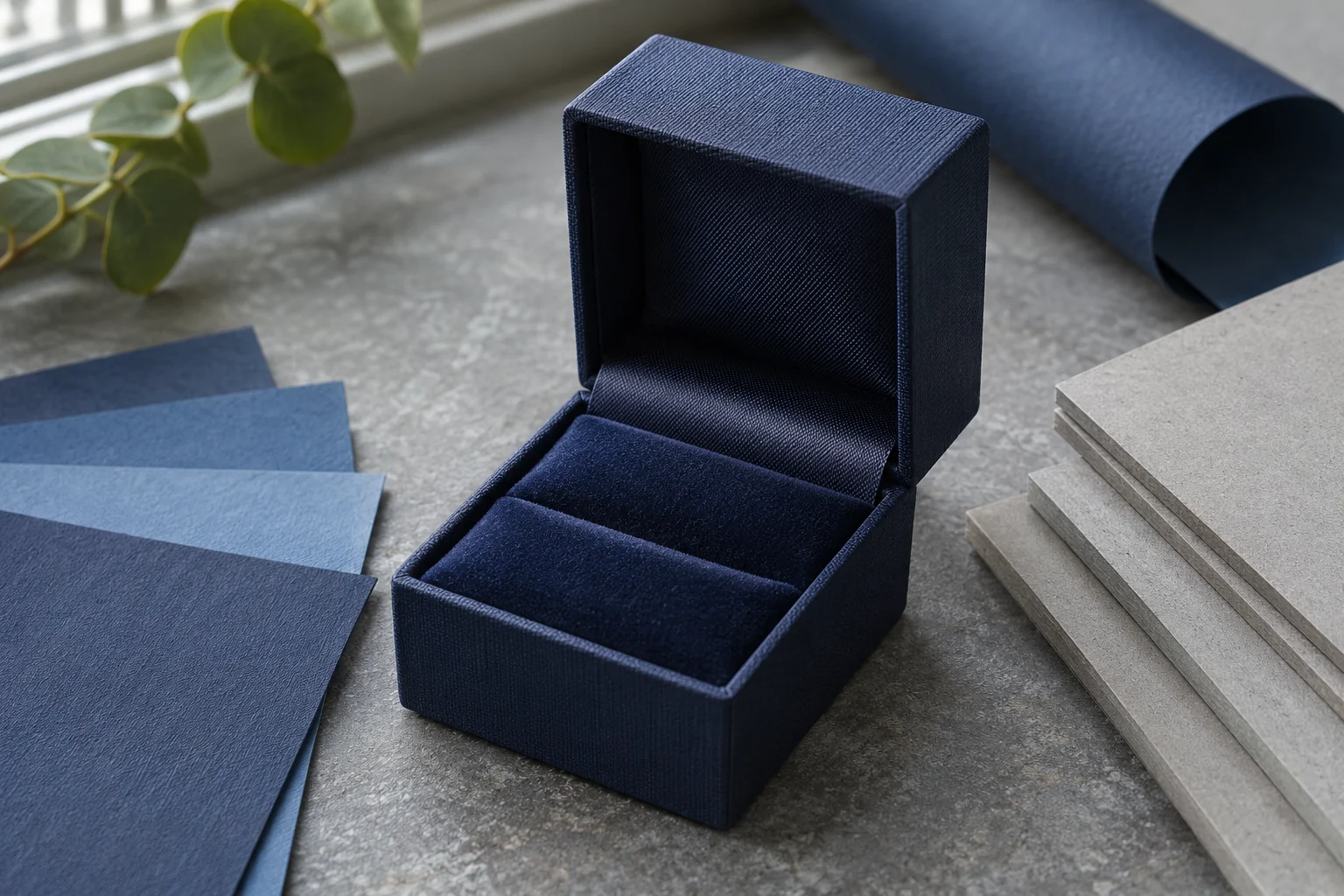
Ring boxes have limited internal space, and their proportions are closely connected to the insert, hinge, lid, and opening mechanism. Increasing the board thickness changes more than the perceived weight of the package. It can reduce usable internal dimensions, affect lid-to-base clearance, change corner construction, and require different forming or wrapping settings.
Consider a hypothetical ring box with a fixed outside width of 70 mm. If two opposite walls each increase from 1.5 mm to 2.0 mm greyboard, the nominal internal width decreases by:
Internal width reduction = 2 × (2.0 − 1.5) mm = 1.0 mm.
This illustrative calculation assumes the external width remains unchanged and each opposite wall contributes directly to the internal dimension. It excludes covering paper, adhesive layers, corner-joint construction, and manufacturing tolerances. It is not a tested HORDA machine result or a universal box-design formula.
One millimeter can matter when the ring insert is already closely fitted. If the insert becomes compressed, it may distort the lining, interfere with lid closure, or place unwanted pressure on the jewelry. Increasing the outside dimensions instead may protect the internal space, but it changes the flat board geometry and potentially the required machine format.
For this reason, greyboard should be selected using the complete package rather than a thickness figure alone. A practical sequence is to qualify candidate boards against an approved box sample for handling rigidity, lid-to-base fit and ring-insert clearance, then compare the surviving board grades with the forming and feeding limits of the intended equipment. A thicker grade that passes a stiffness check but compromises insert clearance or minimum-format handling is not an automatic upgrade.
For a book-style wrapped-case construction, distinguish the rigid panels from the flexible hinge region. That hinge region is typically created through the arrangement of separate board pieces, gaps, and flexible covering material. A conventional thick greyboard panel should not be assumed capable of repeated sharp folding without a deliberately designed hinge or joint construction.
How Cover Paper Affects Folding, Glue Application, and Corner Quality
The cover paper is usually the first material the customer sees, but its suitability depends on more than print quality or surface texture. It must tolerate the mechanical actions involved in feeding, gluing, positioning, wrapping, and edge turn-in.
Folding and grain direction
When the cover paper folds around a board edge, the material on the outside of the bend experiences tensile strain. Brittle coatings, heavy decorative layers, or an unfavorable grain direction may increase the risk of visible cracking. Paper grain direction can also influence springback and the way corners settle after folding.
The correct approach is not to assume that a lower gsm always folds better. Fiber composition, actual caliper, coating flexibility, moisture condition, folding radius, and any pre-creasing operation all matter. The AIMS Group’s creasing and folding guidance explains the importance of crease construction and grain orientation in reducing surface cracking.
Its general principles are useful when reviewing ring-box cover materials, although actual wrapped-cover trials must account for the specific board edges, corner geometry, and machine mechanism rather than treating rigid-box wrapping as identical to folding-carton creasing.
Corner turn-in and decorative finishes
At a straight edge, the paper can often be turned around the board with a relatively simple fold. At a small corner, several material layers may need to occupy a limited area. If the covering paper is too stiff for that geometry, or the corner-cutting and relief pattern is unsuitable, the material can bunch together and create a raised or wrinkled corner.
Changing the paper grammage may help, but it is not always the main correction. The buyer should also examine:
- Corner relief cuts and the amount of paper left for turn-in.
- Board edge quality and whether the board dimensions are consistent.
- The covering sheet’s actual thickness, coating and grain orientation.
- Folding-tool alignment, pressure, and the sequence of edge wrapping.
- Adhesive application and whether excess glue increases local bulk.
Specialty papers, textured sheets, metallic finishes, films, and laminated artwork require particular attention. A finish that looks acceptable on a flat sample may crack, wrinkle, scuff, or become difficult to bond when folded around the actual ring-box corner.
Glue selection is part of material compatibility
Adhesive performance depends on the surfaces being joined. The glue must wet the relevant surface, maintain workable tack until the parts meet, and develop sufficient bond strength during pressing and subsequent drying or setting.
For water-based adhesives, surface absorbency, glue amount, moisture transfer, open time, and pressing conditions can affect the result. A heavily coated or film-laminated surface may behave differently from uncoated paper. The adhesive should therefore be selected for the actual substrate pair and the application method rather than assumed suitable because it works with another paper grade.
Excess adhesive can cause squeeze-out, staining, moisture-related deformation, or prolonged drying. Insufficient adhesive, poor wetting, or inadequate pressing may produce edge lifting and delamination. If a glossy paper repeatedly lifts from the board, increasing glue quantity without first checking the bondable surface may simply create a different defect.
The adhesive supplier’s technical data, the equipment’s glue-application method, and trials using the production materials should jointly determine the process settings.
Which Packaging Machines Can Process Ring Box Materials?
Machine compatibility must be evaluated by operation, not by the commercial label “ring box machine.” A complete ring box can require board preparation, rigid-body forming, exterior wrapping, inner lining, insert preparation, hardware fitting, and final assembly. The required route changes according to whether the product is a two-piece lid-and-base box, a hinged presentation box, or another rigid construction.
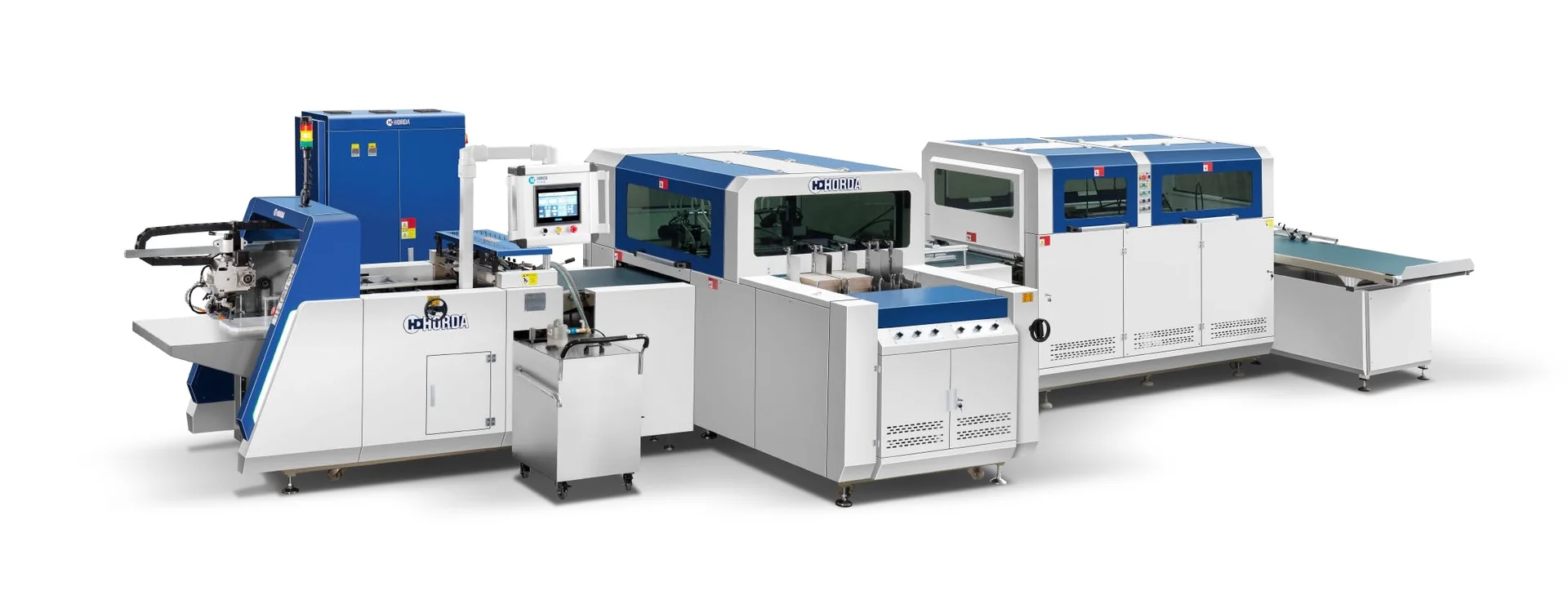
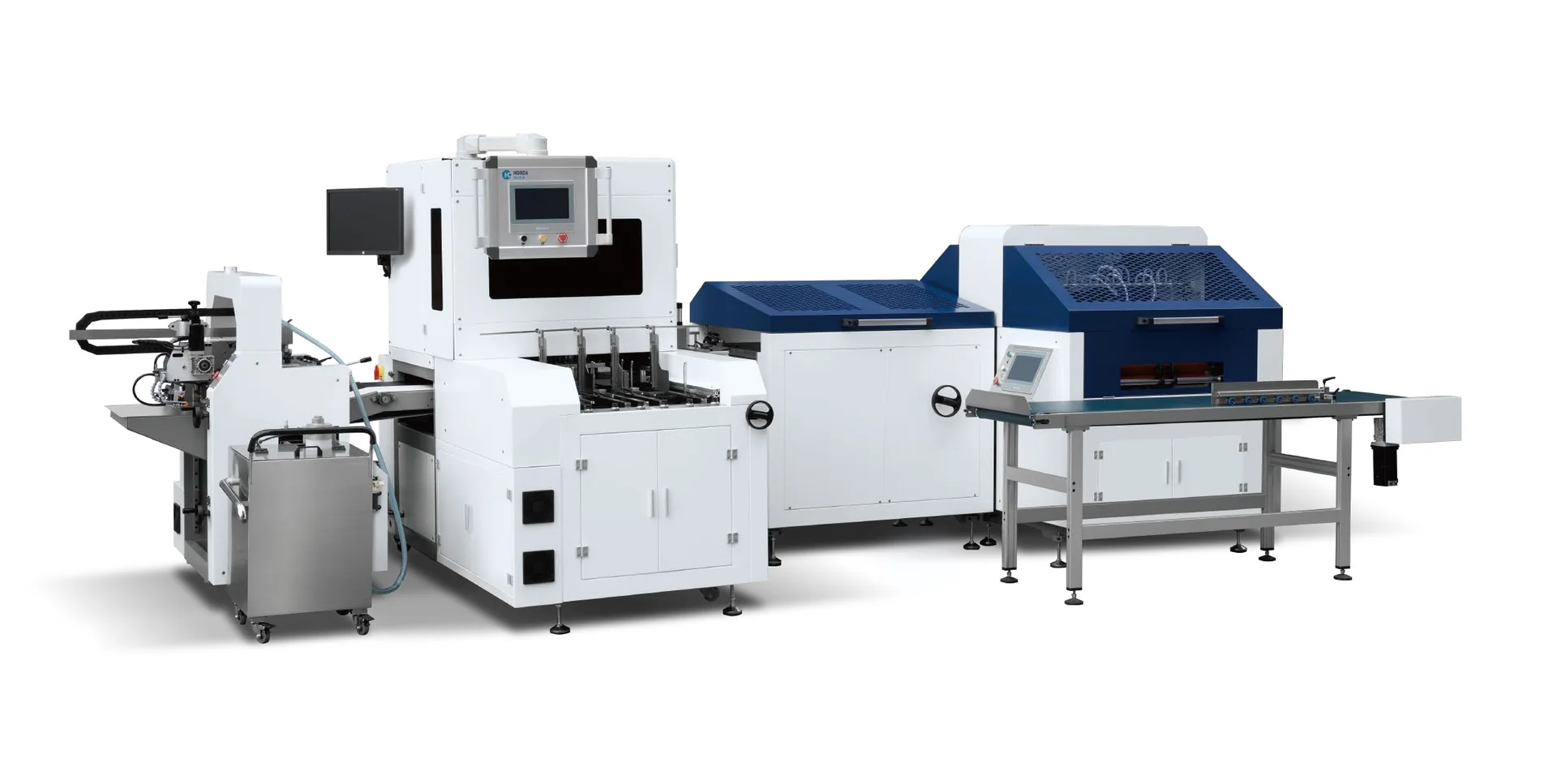
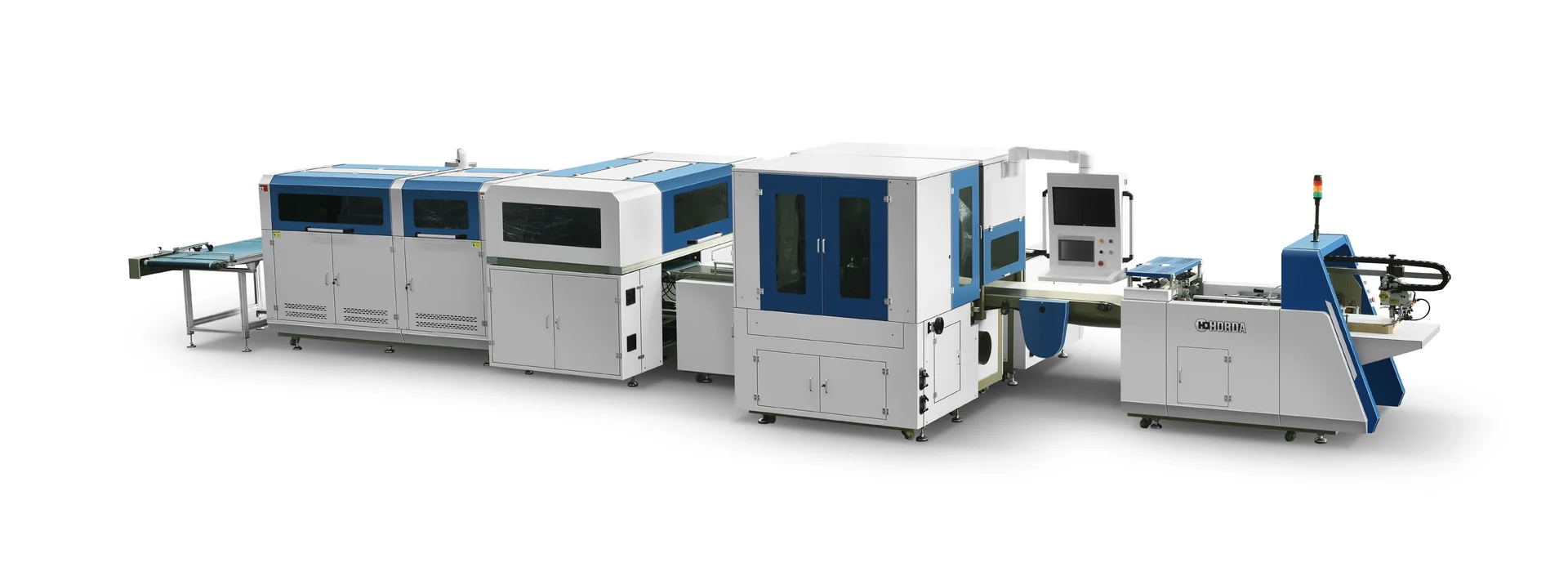
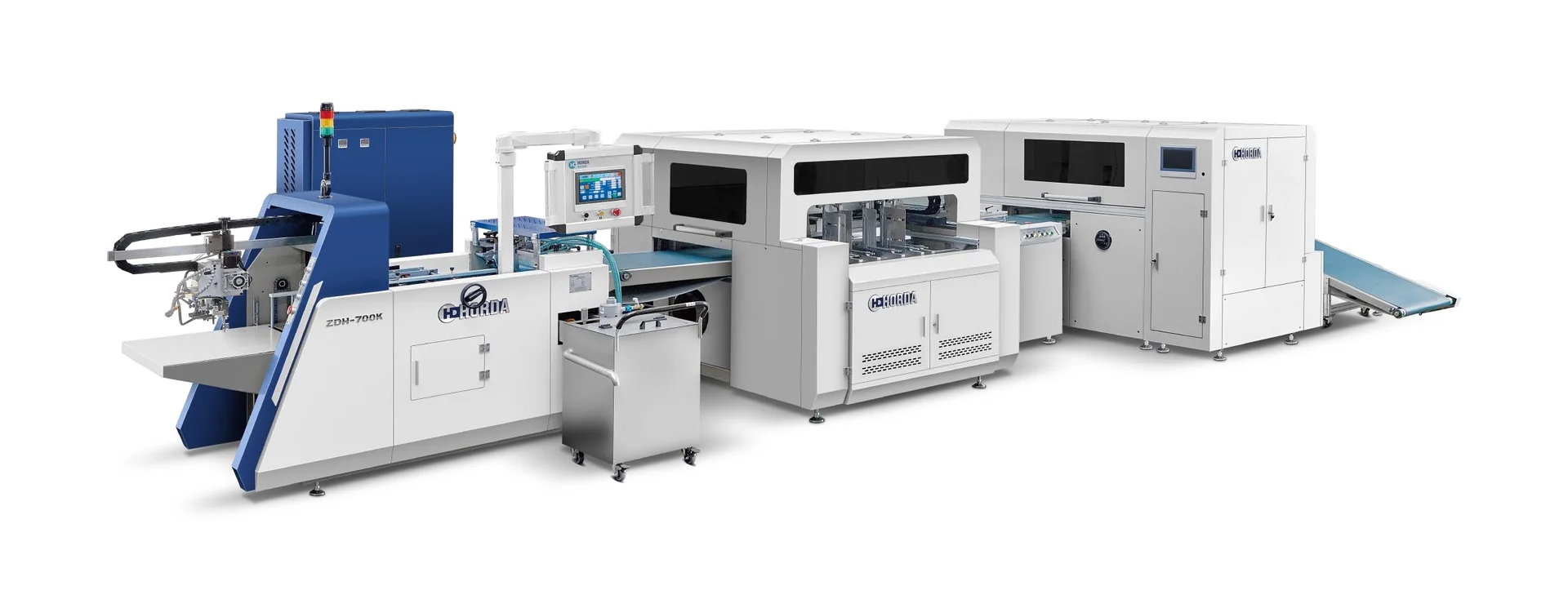
The HORDA equipment catalogue supplied for this project identifies distinct equipment categories for automatic case making, linked case making and inner laminating, standalone inner laminating, collapsible-box operations, and rigid-box production solutions. These categories should not be treated as interchangeable.
| Production operation | Material and process requirement | Machine compatibility boundary |
|---|---|---|
| Greyboard cutting and preparation | Accurate board dimensions, clean edges, appropriate scoring or separation where required | The cutting or preparation equipment must support the selected thickness and individual component sizes |
| Hardcover case making and wrapping | Board-piece feeding, cover-paper feeding, gluing, registration, edge folding and collection | HORDA ZFM case-making machines are relevant to wrapped-case production, subject to specific model, configuration and material-format verification |
| Rigid box body forming | Formation of the base, lid or other three-dimensional rigid structure | Requires an appropriate rigid-box forming operation; a flat hardcover case maker alone is not proof of finished box-body capability |
| Inner paper laminating | Liner feeding, adhesive application, positioning and lamination | HORDA ZTC inner laminating equipment or relevant QZFM linked configurations may be considered for suitable components, subject to minimum format and material trials |
| Collapsible wings or specialized covers | Multiple board segments and dedicated collapsible structures | HORDA DFM and ZDH operations apply to specified cover or wing processes, not automatically to ordinary rigid ring boxes |
| Insert and final assembly | Ring pad, fabric, foam or tray fitting, hinge hardware and final inspection | Must be separately defined; these operations are not automatically included with case making or lining equipment |
For example, a book-style ring box may need a wrapped outer case, a separate formed compartment, an inner lining, and a fitted ring pad. A two-piece rigid ring box may instead place greater emphasis on lid-and-base forming and exterior wrapping, with no three-panel book-style cover.
Even where the same material grades are used, these products can require different machines and tooling. A HORDA model listed for hardcover case making is not automatically suitable for forming the complete three-dimensional box.
HORDA’s catalogue also lists model-specific paper-weight, board-thickness, and working-format parameters. For example, the ZFM-700K table in the supplied HORDA equipment catalogue (printed pp. 15–16) lists a board-thickness range of 1.0–3.0 mm, a minimum “product size” of 90 × 180 mm, an 8 mm minimum spine width, and a 25 mm minimum side-board width. The paper-weight unit is printed as “g,” not explicitly g/m². These are catalogue screening entries for that model, not a verified material window or ring-box performance guarantee. Confirm what “product size” measures, the paper-weight basis, machine revision, feed orientation and tooling before relying on any of these figures in a purchase specification.
Why Small Ring Box Dimensions Can Cause Machine Compatibility Problems
A small finished box does not necessarily correspond to a small machine-processing sheet, and a sheet that fits a machine’s maximum dimensions may still fall below its minimum format or individual board-feeding limits.
Consider a hypothetical three-panel hinged ring-box cover made from two 70 × 70 mm boards and a 25 × 70 mm spine board. Assume two 3 mm hinge gaps and a 12 mm paper turn-in allowance on every outside edge.
The nominal board-and-gap span would be:
70 + 3 + 25 + 3 + 70 = 171 mm.
If the cover paper extends 12 mm beyond the outermost board edges on all four sides, its nominal rectangular sheet dimensions would be:
Length = 171 + 12 + 12 = 195 mm.
Width = 70 + 12 + 12 = 94 mm.
These are illustrative layout calculations, not a production dieline, manufacturer specification, or evidence of compatibility with a particular machine. The final sheet design must also account for corner cuts, actual board placement, adhesive, folding geometry, print registration, tooling, and the intended feed orientation.
The example shows why an RFQ stating only “70 mm ring box” is insufficient. Here, 195 × 94 mm describes the hypothetical covering sheet, while 171 × 70 mm describes the outer span of the laid-out board arrangement; neither describes the finished closed box. The manufacturer must compare each defined size object with the appropriate machine limit, along with the separate board components, spacing and required feed orientation.
For compact jewelry packaging, minimum component width, pickup stability, registration detectability, and effective fold-tool access can become the deciding factors even when the maximum working format is more than sufficient.
Printed positioning also requires care. Photoelectric registration and CCD visual positioning are different detection approaches, and neither guarantees consistent output for every decorative finish. Artwork, registration marks, gloss, reflectivity, print variation, and the actual positioning system must be evaluated together. A catalogue positioning figure is not a guarantee of finished ring-box corner alignment.
Common Material Defects and How to Diagnose Them
When a ring-box trial produces defects, changing the greyboard or cover-paper grade immediately can obscure the real cause. Begin with the visible symptom, then separate material-related causes from feeding, gluing, tooling, and positioning problems.
| Observed defect | Possible mechanisms | Useful verification |
|---|---|---|
| White cracks or broken coating at a fold | Excessive folding strain, unsuitable grain orientation, brittle coating or film, or insufficient crease preparation where pre-creasing is part of the process | Compare grain orientations and finish constructions; inspect where cracking starts using the same fold geometry |
| Raised or wrinkled wrapped corners | Excess material at corner relief, heavy or stiff wrap, inaccurate cuts, folding-tool mismatch or glue buildup | Inspect flat corner cuts, dry-fold a sample, compare paper caliper and verify board edge dimensions |
| Cover paper lifting from greyboard | Inadequate adhesive wetting, contamination, incorrect open time, poor pressure or incomplete setting | Inspect the separation interface, test the actual substrate and adhesive combination, and review pressing and drying conditions |
| Warped panel or uneven lid fit | Uneven moisture uptake, asymmetric lamination, board variation, adhesive application or assembly geometry | Check board and paper condition before and after gluing, panel flatness, liner construction and drying consistency |
| Printed wrap shifted relative to the board | Feeding skew, unstable pickup, inaccurate registration, artwork distortion or inconsistent board positioning | Check sheet orientation, detection marks, board placement and repeatability on consecutive samples |
| Inner liner bubbles or wrinkles | Uneven adhesive distribution, trapped air, inadequate pressure, liner curl or dimensional mismatch | Review liner flatness, glue coverage, positioning and lamination sequence |
These are diagnostic possibilities rather than confirmed failure causes. A defect that appears only with one laminated paper may indicate a material-finish interaction; a defect that occurs with several papers at the same board position may point more strongly toward tooling, placement, or handling.
Trials should change one significant variable at a time where practical. Keep an approved reference sample, record the material lot and machine settings, and evaluate whether the proposed correction improves the relevant defect without creating another one. Any mechanical adjustment or maintenance activity must follow the equipment manufacturer’s safety and operating instructions.
How to Qualify a Greyboard and Cover Paper Combination Before Buying Machinery
Material compatibility should be demonstrated using the actual intended production construction. A generic demonstration with a convenient paper grade does not establish performance with the buyer’s laminated wrap, selected greyboard, liner, or small ring-box geometry.
A useful pre-purchase trial should cover the following:
- Freeze the ring-box construction. Identify whether it is a hinged, two-piece, book-style, or other rigid format. Supply a finished sample and drawings of the separate flat and formed parts.
- Document the complete material specification. Record greyboard thickness and tolerance; cover-paper grammage, caliper and grain direction; coatings or films; liner material; and the proposed adhesive. Provide representative production material samples.
- Confirm the required machine operations. Identify which station cuts the board, creates the wrapped cover, forms the box body, applies inner lining, installs the insert, and assembles the final package. The quotation should distinguish included equipment from separate operations.
- Verify minimum and maximum formats. Compare the complete covering sheet, individual board pieces, gaps, and feed orientation with the actual machine configuration. Do not rely on the finished closed-box dimensions alone.
- Trial the difficult features. Include the smallest box, the tightest corners, the selected decorative finish, representative printed artwork, and any liner or hinge construction that is likely to challenge feeding or folding.
- Inspect consecutive acceptable output. Agree in advance on dimensional and visual acceptance criteria, inspection methods, trial duration, and the definition of an accepted piece. Record rejects and interruptions rather than reporting only the highest observed machine cycle rate.
For a premium ring box, the inspection should cover corner appearance, exposed adhesive, visible registration, liner wrinkles, lid-to-base fit, opening and closing behavior, and insert clearance. Acceptance tolerances should be specified against an approved sample or drawing; arbitrary numerical limits should not be assigned without agreement.
Production capacity must also be measured at the correct output stage. A case-making machine producing acceptable wrapped covers does not necessarily establish the number of complete, lined, assembled, and inspected ring boxes that the factory can ship per shift.
For a multi-station operation, the sustainable output depends on the effective bottleneck, changeovers, material handling, downtime, and accepted yield. Equipment specifications should therefore distinguish catalogue cycles per minute from actual good covers or finished boxes per shift.
What to Include in a Ring Box Machinery RFQ
A strong machinery inquiry should make it possible to reject an unsuitable configuration early, before tooling or production commitments are made.
Provide a complete package consisting of the finished box sample, its open and flat component drawings, minimum and maximum production sizes, actual greyboard and covering-paper samples, liner and insert requirements, decorative finishes, expected product mix, and target accepted output per shift.
Ask the equipment supplier to confirm the applicable machine model and revision, supported operations, minimum board and paper formats, material-handling limitations, compatible adhesive application, tooling or options required, and how the proposed process will be tested.
The written proposal should also identify which party supplies auxiliary equipment, box-body forming, insert installation, final assembly, commissioning, training, warranty, and after-sales support. These responsibilities should not be inferred from a catalogue photograph or a general production-line description.
Review Your Ring Box Materials and Production Route
The most reliable ring-box material specification is one that works as a complete system: structurally suitable greyboard, foldable and bondable covering paper, compatible lining and adhesive, correct flat geometry, and machinery qualified for the required operation.
If a ring-box design is ready for equipment evaluation, send the project requirements to Raymon Machinery. Include the box construction, finished and flat dimensions, greyboard thickness, cover-paper gsm and finish, material samples, target output, and operations you intend to automate.
Raymon Machinery is an independent equipment information and quotation-coordination channel featuring HORDA machinery. The review can establish which HORDA equipment categories and configurations merit further technical confirmation. Final machine suitability, trial arrangements, supply scope, and commercial responsibilities must be confirmed in the current written proposal.
For broader application planning, see the jewelry and watch packaging machinery application guide. For dimensional preparation, the flat-layout measurement guide explains the information needed for machine-format screening.