
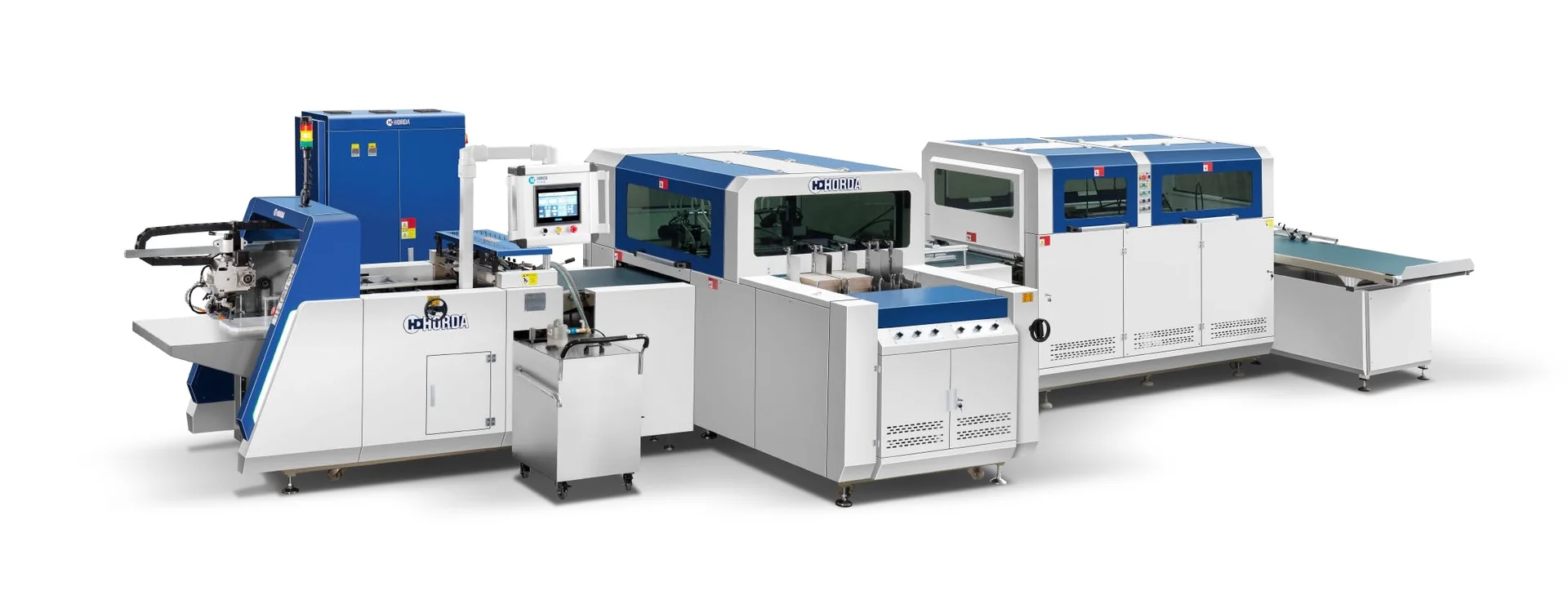
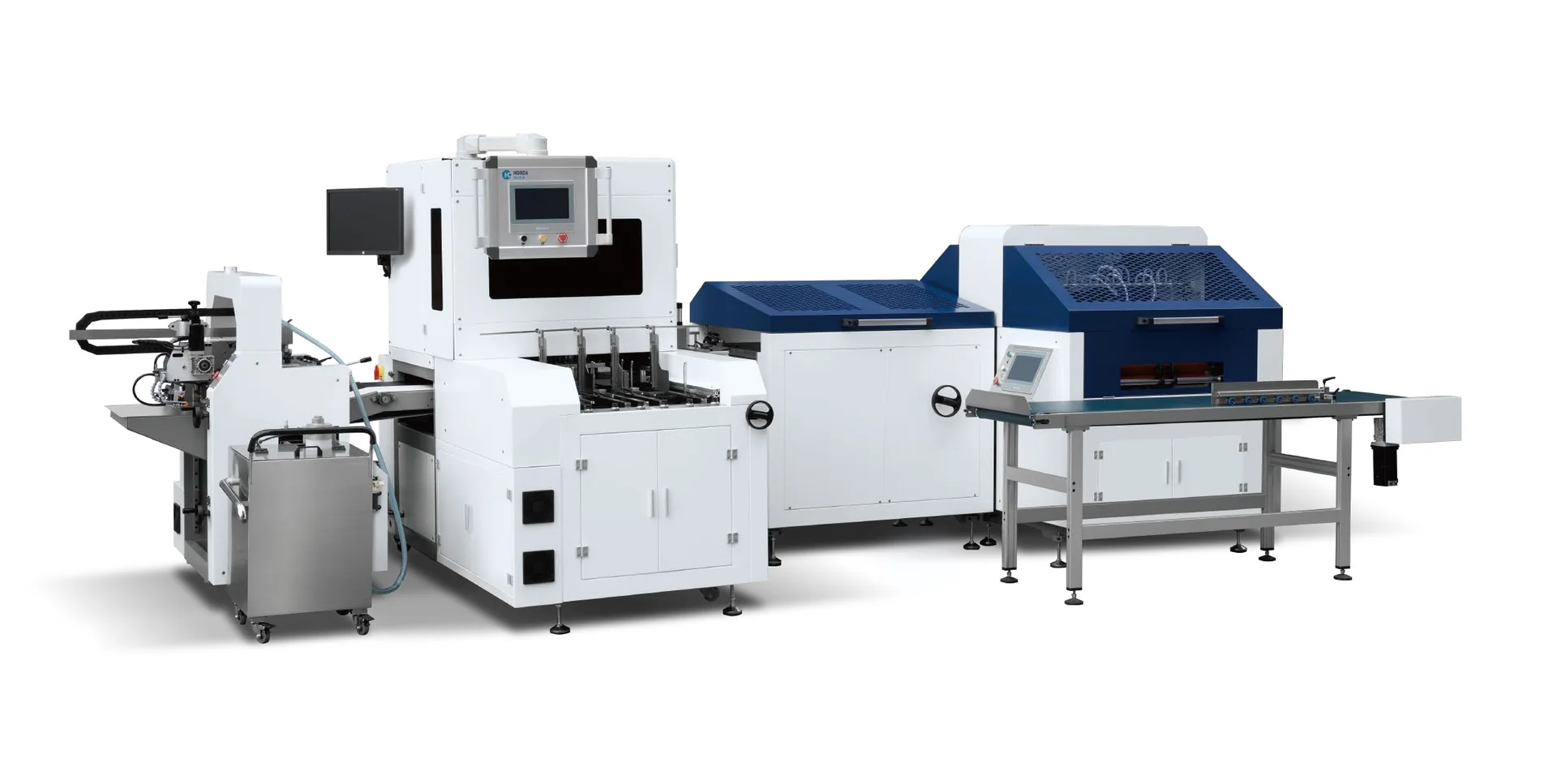
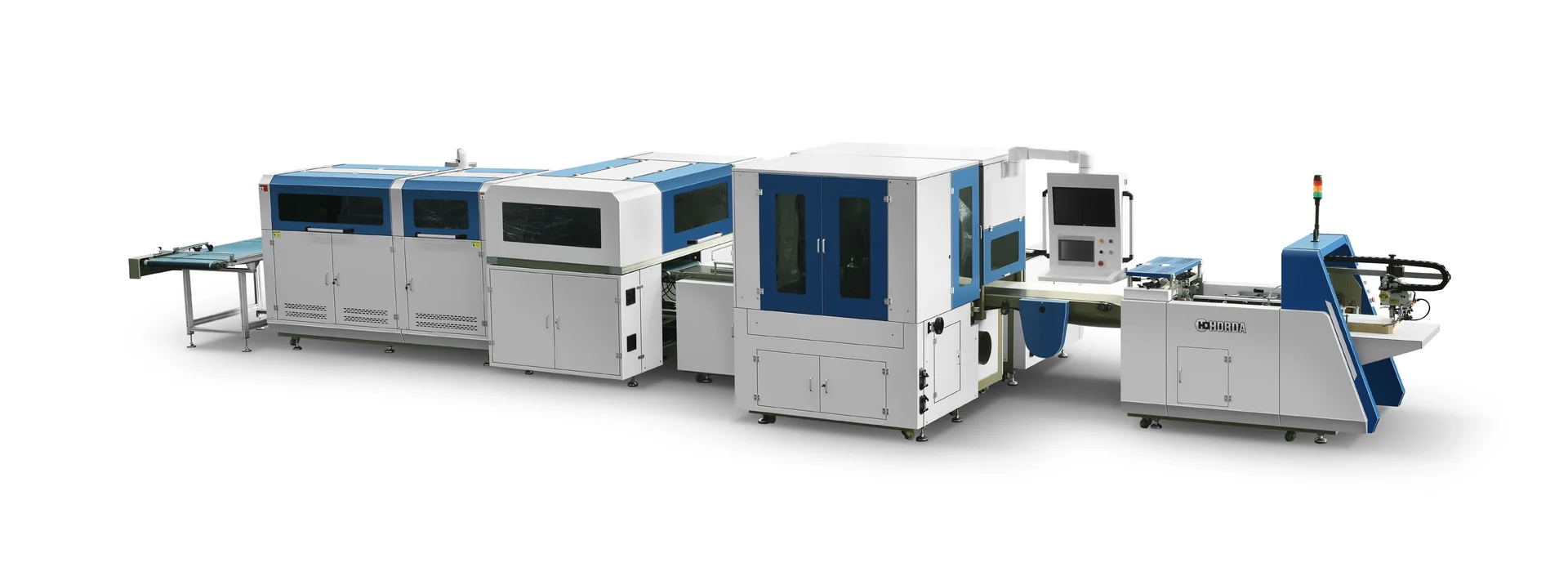
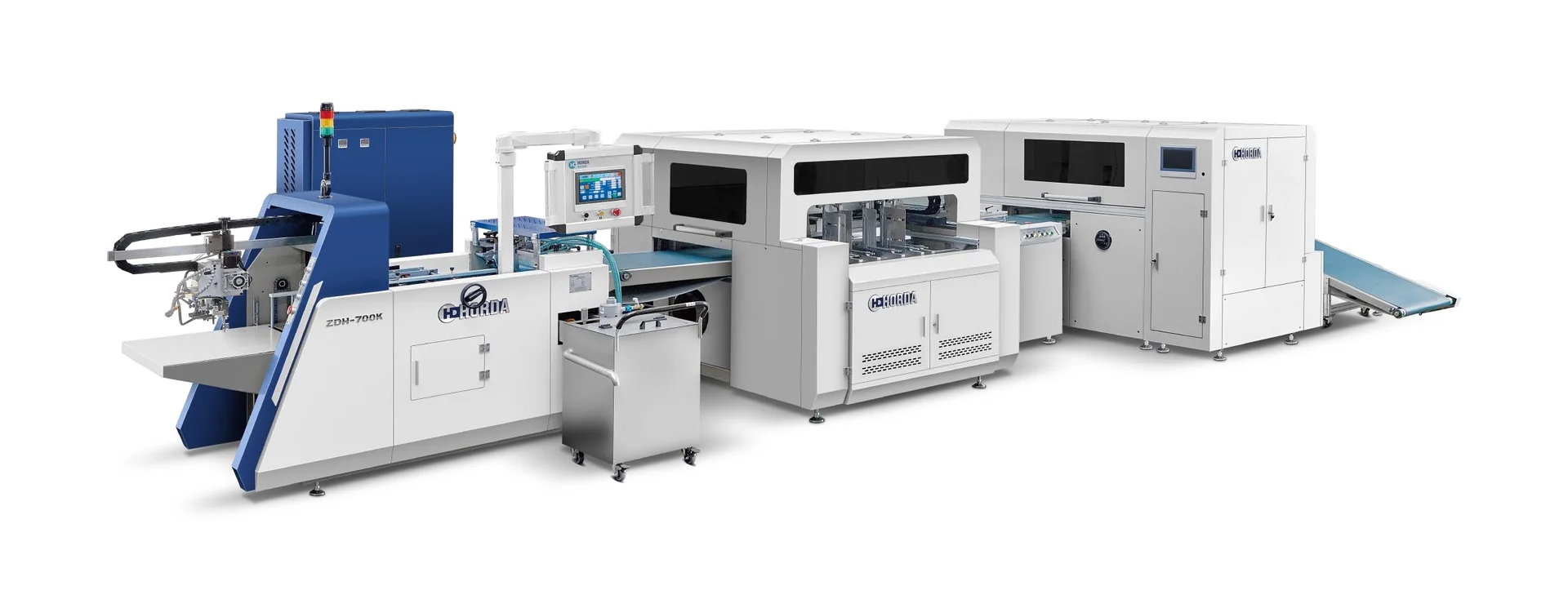
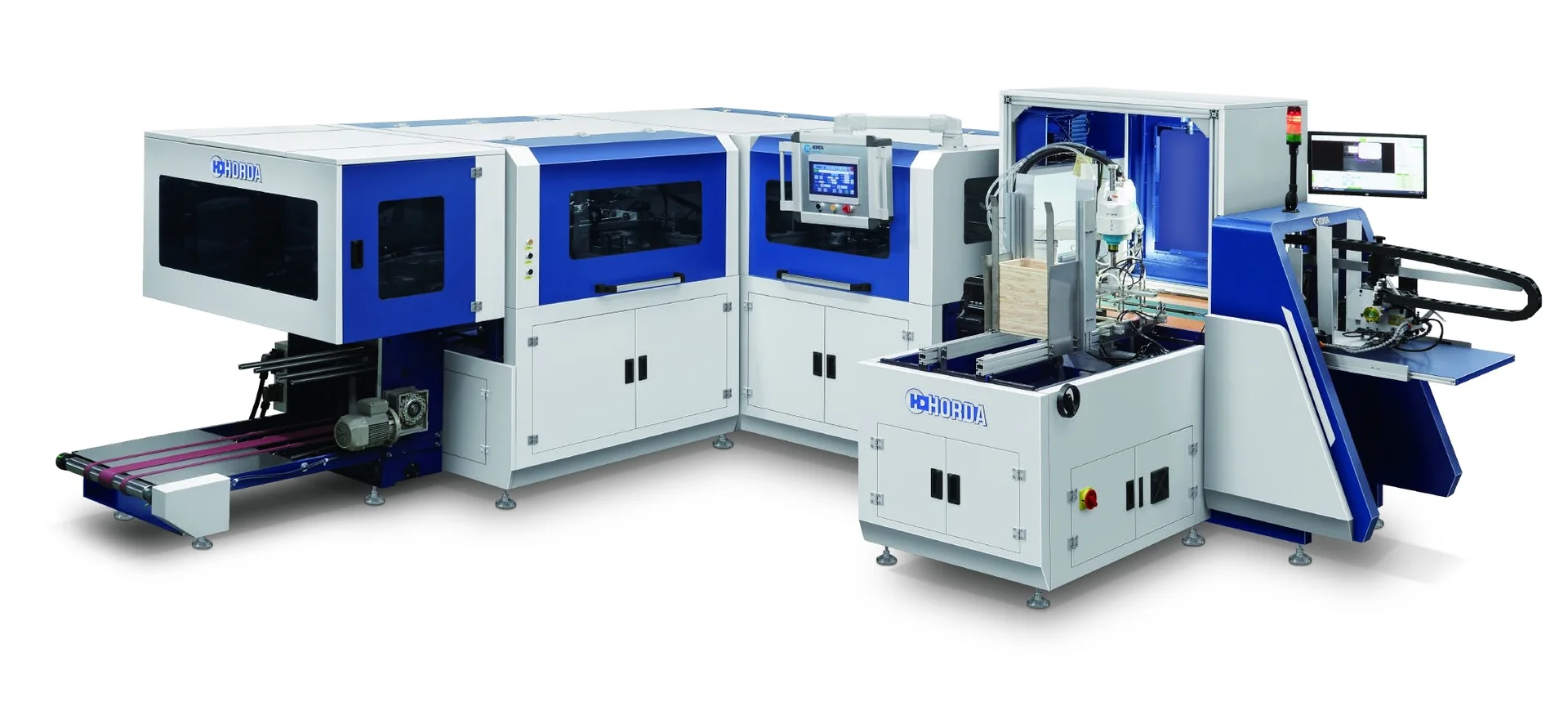
A typical rigid watch box production workflow begins with structural design and material preparation, followed by box-body forming or hardcover case making, surface wrapping, inner lining, insert preparation, final assembly, and quality inspection. The exact sequence depends on whether the watch box uses a hinged book-style cover, a lift-off lid and base, or a drawer construction.
The most important distinction is that case making, inner lining, and finished watch box assembly are different operations. A case-making machine may produce a wrapped outer cover, but it does not necessarily form the internal tray, install the watch cushion, fit the closure hardware, or deliver a retail-ready box. A manufacturer planning watch box production must identify these separate operations before selecting machinery.
This guide explains the production stages, where automated equipment fits, which materials and dimensions control feasibility, and how to establish quality checks that reveal defects before final assembly.
Start with the Watch Box Structure, Not the Machine
Two watch boxes with the same outside dimensions may require different production equipment. Their construction determines which components must be manufactured separately and how those components are joined.
| Watch box construction | Main structural components | Required production route | Critical quality concern |
|---|---|---|---|
| Book-style hinged box | Wrapped flat case, spine or hinge area, internal tray, watch holder | Case making, optional case lining, tray forming and wrapping, final assembly | Hinge movement, tray alignment, closure fit |
| Lift-off lid and base | Separate three-dimensional lid and base, lining, internal support | Board preparation, shell forming, corner fixing, wrapping, lining, assembly | Lid-to-base clearance, corner squareness, opening resistance |
| Drawer-style watch box | Outer sleeve, sliding inner tray, watch holder | Sleeve preparation and wrapping, tray forming, lining, assembly | Sliding clearance, friction, tray retention |
A hinged watch presentation box is a useful example. Its outer case normally contains separate rigid board panels held together by a flexible covering material. The covering forms the visible exterior and accommodates opening at the spine or joint. A three-dimensional tray is then attached inside the case, and a cushion or other insert supports the watch.
By contrast, a lift-off lid is already a three-dimensional structure. Its production requires shell forming and wrapping rather than simply making a flat hardcover case. Selecting a flat case-making machine as the only production machine would leave a substantial part of that workflow uncovered.
Equipment selection rule: Obtain an approved finished sample and identify every separately manufactured component. For each component, define its incoming material, processing operation, and expected output before comparing machine models.
The Watch Box Production Workflow: Seven Practical Stages
1. Define dimensions, construction, and the approved sample
Before materials are cut, the packaging engineer needs more than the closed-box length, width, and height. The production drawing should identify the opened structure, board pieces, fold lines, hinge gaps, wrapped edges, inner tray, insert position, and closure arrangement.

For a hinged case, the distance between the spine panel and adjacent panels determines how the cover bends. A gap that is too narrow can restrict opening and concentrate stress in the covering material. A gap that is too wide can produce an unstable hinge or undesirable movement between the case and tray.
The watch itself also establishes functional requirements. The holder must accommodate the case diameter, strap or bracelet configuration, watch thickness, and any projecting crown or controls without forcing the product against the box walls or lid.
These dimensions should be approved together. A box that looks correct when empty can still fail when the watch and cushion are installed.
2. Prepare the greyboard, covering material, and liner
Rigid watch boxes commonly use greyboard or chipboard as their structural material, combined with decorative covering paper or another suitable wrapping material. The covering may be printed, textured, laminated, foil-stamped, or otherwise finished before assembly.
Board cutting must produce consistent panel dimensions and clean edges. For hinged cases, separate panels and the spine must be prepared to the specified layout. For three-dimensional shells, the board may require cutting, grooving, scoring, and corner fixing before wrapping.
The covering material is cut with sufficient allowance for its required turn-in and corner construction. This allowance cannot be chosen independently of board thickness, corner geometry, and the selected folding mechanism.
At this stage, inspect the board for thickness variation, damaged edges, warpage, and inconsistent cutting. Check covering sheets for curl, printing defects, scratches, and dimensional variation. A defective blank should not be expected to become accurate merely because it passes through an automatic wrapping station.
3. Produce the outer case or three-dimensional box shell
The third stage follows one of two principal machinery routes.
Flat hardcover case-making route: A case-making machine feeds covering paper, applies adhesive, positions prepared board pieces, folds the covering over the edges, and delivers a wrapped flat case. Depending on the model and configuration, registration may use photoelectric detection, a camera-based vision system, or another positioning arrangement.
This is the relevant route for many book-style watch boxes. It establishes the exterior panels, hinge geometry, and visible wrapped surface, but the output remains a case component rather than a complete presentation box.
Three-dimensional rigid-box route: For a lift-off lid, base, or tray, the board is first formed into a stable shell. Corners may be secured using an appropriate fixing process. Glued decorative paper is then positioned and wrapped around the shell, with the edges turned inward and pressed.
The distinction is mechanically important. Flat case making primarily controls the placement and edge folding of board panels on a covering sheet. Three-dimensional shell wrapping must also control wall position, corner geometry, and the interaction between the formed shell and the wrapping mechanism.
The Paperboard Packaging Council’s explanation of rigid box construction documents the separate board-forming and wrapping operations used in conventional rigid-box manufacture.
4. Apply the inner lining
Inner lining is a separate bonding operation that covers selected internal surfaces or exposed wrapping edges. On a hinged watch box, the liner can improve the appearance of the inside case and cover portions of the turned-in exterior material.
In a typical flat case-lining process, the lining sheet is fed, coated with adhesive, registered against the prepared case, bonded, and pressed. The accuracy of this operation depends on the condition of both components, the positioning method, adhesive behavior, and the liner’s dimensional stability.
A misaligned liner may expose unequal margins. Trapped air or inconsistent bonding may create bubbles, while excessive adhesive can cause staining, surface distortion, or contamination around the hinge.
The lining material should also be checked after folding the case. A liner that appears smooth when flat may crease or pull away when the hinge opens.
5. Manufacture the internal tray and watch holder
The internal tray or support is where the packaging begins to perform its product-retention function. Depending on the design, this stage may involve a wrapped board tray, molded insert, fabric-covered support, watch pillow, or a combination of components.
A paperboard tray may be produced using rigid-box forming and wrapping equipment. A foam insert, molded support, or upholstered watch cushion follows a different manufacturing route and should not automatically be included in the scope of a case-making or inner-laminating machine.
Insert selection requires functional testing. A cushion that is too large may compress the watch strap excessively or prevent the lid from closing. A support that is too small may allow movement during handling. Surface materials and adhesives must also be evaluated for possible marking, residue transfer, or other unwanted contact with the watch.
The required holding force and allowable movement should come from the approved packaging specification and physical samples, not from an assumed universal watch-box dimension.
6. Assemble the case, tray, inserts, and closure
For a book-style watch box, assembly generally involves positioning and bonding the finished tray inside the wrapped case. Any required magnets, metal plates, pull ribbons, decorative fittings, or other closure components must be installed at the appropriate stage of the specific design.
Some hardware may need to be installed before the inner lining conceals it. Other accessories are fitted after the main components have been bonded. The order must therefore be established during product engineering rather than assumed from a generic machine diagram.
Assembly accuracy affects the finished appearance and function. Even when the case and tray individually meet their dimensions, inaccurate tray placement can cause unequal borders, poor closure alignment, or interference at the hinge.
Pressing and adhesive setting must follow the requirements of the selected materials. A component should not be treated as ready for final inspection solely because it has left the gluing station.
7. Complete functional inspection and protective packing
The finished box is inspected with its intended insert and a representative watch or dimensionally equivalent inspection fixture.
Inspectors should evaluate the closed appearance, opening and closing action, product retention, surface condition, and any visible alignment requirements. The box should remain functional after the adhesive and components have reached the agreed inspection condition.
Finished watch boxes are then protected against crushing, rubbing, and contamination during handling and transport. The packing method must be appropriate for the exterior finish and the way the boxes are stacked or separated.
Case Making vs. Inner Lining: Which Equipment Performs Each Operation?
Case making and inner lining are often discussed together because they can be connected in an automated production route. They are nevertheless distinct manufacturing operations with different inputs, working mechanisms, and quality requirements.
| Operation | Machine input | Main machine action | Output |
|---|---|---|---|
| Hardcover case making | Prepared rigid board panels and covering sheets | Feeding, gluing, board registration, four-side edge folding | Wrapped flat case |
| Inner paper laminating | Prepared case and lining paper | Liner feeding, gluing, positioning, bonding and pressing | Lined case |
| Rigid-box shell forming and wrapping | Prepared board blank or shell, covering material | Shell forming or corner fixing, positioning, wrapping and pressing | Three-dimensional wrapped shell |
| Final watch box assembly | Prepared cases, trays, holders and hardware | Component fitting, bonding, alignment and functional checking | Assembled watch presentation box |
HORDA’s published equipment range illustrates this functional separation. The ZFM family includes case-making machines for wrapped hardcover cases, while the ZTC range covers case lining and inner-paper laminating. HORDA’s 2026 equipment catalogue identifies QZFM linked case-making and inner-laminating machines in which the wrapped case is transferred from the case-making section to the lining section.
The manufacturer’s online case-making and lining description explains four-side folding and subsequent inner-paper laminating, but its displayed QZFM-700/1000A designation differs from the QZFM-700/1000K and QZFM-700/1000B/B-II variants shown in the 2026 catalogue. These are source-specific model identities; their capacities, controls, and specifications must not be assumed interchangeable.
This establishes the process functions, not universal watch-box compatibility. Whether a particular model can process a small watch-box case depends on the actual flat format, board layout, covering material, liner, positioning requirements, and current machine configuration.
Do not assume that an integrated case-making and lining line includes tray forming, cushion production, magnet fitting, or final watch box assembly. Those operations must be identified separately in the equipment proposal.
Material and Dimension Checks That Determine Production Feasibility
Small premium watch boxes can be difficult to manufacture consistently because modest dimensional or surface variations become noticeable around narrow borders, corners, hinges, and fitted inserts. The following checks should be completed before machinery is selected.
Finished dimensions are not the machine’s flat working format
A closed watch box measuring a particular length, width, and height does not establish the size of the covering sheet or the flat case processed by a machine.
A book-style construction may need space for the front panel, rear panel, spine, hinge gaps, and wrapped edges. These features determine the overall flat layout. A lid-and-base design instead requires the working dimensions of its board blanks or preformed shells.
Machine data must therefore be compared against the correct workpiece definition. Some equipment limits refer to a flat case or processed cover, while other limits may describe a box shell or another component.
Buyers should provide both the smallest and largest required flat components, not only the outside dimensions of the finished product. A machine can have adequate maximum capacity but still be unsuitable for a small job because of minimum feeding, board-piece, spine, or folding constraints.
Board thickness and covering-paper weight measure different properties
Rigid board thickness is normally specified in millimetres, while covering-paper basis weight is normally specified in grams per square metre (g/m² or gsm).
These values are not interchangeable. Paper weight alone does not establish thickness, bending stiffness, surface friction, or feeding behavior. Likewise, nominal board thickness does not confirm its density, flatness, or resistance to deformation.
The specification should identify the actual board grade and thickness, covering material and basis weight, coating or lamination, liner properties, and permissible incoming-material variation.
Decorative finishing changes how the material behaves
A premium watch box may use soft-touch laminate, textured paper, metallic foil, coated paper, or another specialty surface. These finishes introduce additional production concerns.
A relatively stiff laminated sheet may resist tight corner folding or produce springback. A textured or coated reverse surface may require adhesive trials. Sensitive finishes may show scratches from contact with guides, belts, or pressing surfaces. Foil decoration near a fold may also require special evaluation because local deformation can affect its appearance.
For glued areas, check which surface the adhesive actually contacts, its ability to wet that surface, the specified open time, application quantity and pressing conditions. A decorative front finish does not necessarily describe the bonding properties of the sheet’s reverse side. The paperboard producer Holmen explains how coating, glue quantity, open time and pressure affect paperboard bonding; the chosen watch-box materials and adhesive still require their own compatibility trial.
These effects cannot be resolved by specifying paper gsm alone. Trial materials should match the intended production stock, printing and finishing method, and adhesive system.
Fit depends on the complete component tolerance stack
For a lift-off lid, the important relationship is between the internal dimensions of the lid and the external dimensions of the base after wrapping. For a hinged box, the relationship includes tray position, hinge movement, closure geometry, and insert height.
Consider a purely hypothetical lift-off lid design:
- Finished internal lid width: 90.0 ± 0.4 mm.
- Finished external base width: 88.8 ± 0.3 mm.
- Nominal total width clearance: 90.0 − 88.8 = 1.2 mm.
- Worst-case minimum total width clearance: 89.6 − 89.1 = 0.5 mm.
- Worst-case maximum total width clearance: 90.4 − 88.5 = 1.9 mm.
These are illustrative design assumptions, not recommended industry tolerances or measured HORDA production results. The calculation assumes compatible measurement references and worst-case dimensional extremes; it does not account for out-of-square geometry, local bulging, humidity-related movement, or surface friction. It measures total width clearance, not a guaranteed equal gap on both sides.
It demonstrates why nominal dimensions alone cannot guarantee consistent lid fit. The buyer must establish an acceptable functional clearance range and verify it using finished, wrapped samples.
Quality Gates: What to Inspect at Each Production Stage
The most effective watch box quality plan checks components before defects become hidden by later assembly. Inspecting only the completed box makes it harder to determine whether a visible problem originated during cutting, wrapping, lining, or final fitting.
| Quality gate | What to inspect | Why it matters | Recommended verification |
|---|---|---|---|
| Incoming materials | Board thickness, flatness, sheet dimensions, finish condition, liner and adhesive identity | Material variation can affect feeding, folding, bonding and final dimensions | Compare delivery samples and material records with the approved specification |
| Cutting and blank preparation | Panel dimensions, edge quality, groove or score position, spine gaps | Incorrect geometry propagates through wrapping and assembly | Measure representative blanks against the released drawing |
| Case making or shell wrapping | Board registration, corner folds, edge coverage, surface marks, adhesive bonding | Visible defects may become difficult to correct after lining | Inspect consecutive output samples under agreed viewing and measurement conditions |
| Inner lining | Liner position, exposed margins, bubbles, adhesion, hinge flexibility | Lining defects affect internal appearance and sometimes movement | Inspect flat and opened cases after the specified adhesive-setting condition |
| Tray and insert preparation | Tray dimensions, holder geometry, cushion fit, contact surfaces | An incorrect insert can prevent closure or fail to retain the watch | Trial with representative watches or an approved inspection fixture |
| Final assembly | Tray placement, hardware alignment, lid fit, closing action, cosmetic appearance | Individually acceptable parts may not assemble into an acceptable box | Functional opening and closing checks with dimensional and visual inspection |
| Finished packing | Surface protection, component stability, stacking and transport arrangement | Accepted boxes can still be damaged after production | Check the agreed packing configuration and conduct project-specific handling tests where required |
Inspection limits should be agreed before production. Examples include allowable visible registration variation, acceptable corner appearance, required lid fit, lining coverage, and watch-retention behavior. No single tolerance or cosmetic acceptance threshold should be assumed for every watch box design.
For high-value presentation packaging, approved reference samples are particularly useful, but a sample alone is insufficient when dimensional or functional characteristics matter. Pair the reference sample with measurable criteria, a defined inspection method, and an agreed sampling or inspection plan. Record the inspection stage and whether the sample was tested flat, assembled, empty or with its intended watch and insert; otherwise, results from different stages may not be comparable.
Common Watch Box Defects and How to Identify Their Causes
When a defect occurs, the first diagnostic question should be: At which stage was the product last confirmed acceptable? This narrows the likely causes and prevents unnecessary adjustment of downstream equipment.
Uneven borders or displaced printed artwork
If the wrapped case has unequal visible borders, check the relationship between printed sheet registration, board positioning, and the finished fold.
Compare the incoming sheet dimensions and registration marks with the board positions before changing machine settings. If all boards shift together relative to the artwork, investigate feeding and registration. If only one panel is displaced, examine the board-cutting dimensions, panel spacing, and board feeding sequence.
Camera-based and photoelectric positioning systems detect features according to their specific designs. Neither system automatically guarantees the finished artwork position when the sheet itself is stretched, cut incorrectly, curled, or otherwise inconsistent.
Wrinkled or bulky wrapped corners
Corner defects can result from unsuitable covering stiffness, excessive or poorly distributed corner material, incorrect trimming, poor folding geometry, or inconsistent board placement.
First distinguish material deformation from a positioning error. If wrinkles repeatedly occur at the same corner on correctly positioned blanks, examine the covering layout, corner relief, board thickness, and fold sequence. If the defect shifts from one corner to another, feeding or positioning instability may be contributing.
A change of paper grade, coating, or laminate can alter the result even when the machine settings and finished dimensions remain unchanged.
Bubbles, lifting, or poor adhesion in the lining
Bubbles may originate from trapped air, irregular adhesive application, distorted material, or insufficient contact during bonding. Edge lifting may also indicate poor adhesion to a coated surface or movement before adequate setting.
Compare defects on the lining material before and after bonding. Review adhesive compatibility, application uniformity, component alignment, and the manufacturer’s recommended processing conditions. Where an adhesive or machine adjustment requires access to moving equipment, follow the applicable operating and safety procedures.
A lid that jams or closes unevenly
Measure the completed lid and base at multiple positions, not just at one nominal width. Check squareness, wall straightness, corner buildup, and changes after adhesive setting.
If the individual dimensions are acceptable but the fit is inconsistent, investigate local distortion or assembly alignment. For hinged cases, examine whether the inner tray interferes with the cover or whether the hinge gap restricts movement.
A watch cushion that moves or prevents closure
This is primarily an insert and final-assembly issue rather than a case-registration problem.
Check the cushion’s compressed dimensions, holder opening, attachment method, and actual watch fit. A lid that closes properly without the watch but not with it indicates that the internal clearance or insert arrangement requires further review.
Do not attempt to correct this problem by changing a case-making machine’s board-position setting unless measurements demonstrate that the outer case geometry is the cause.
How to Estimate Production Output Without Confusing Cases and Finished Boxes
Equipment catalogues commonly express production speed as pieces per minute. For watch box planning, that number must be associated with a specific operation and output unit.
A flat case-making rate describes wrapped cases. An inner-laminating rate describes lined cases. Neither automatically measures the number of completed watch boxes that can be packed during a shift.
Illustrative hypothetical production example: Consider a production route with the following assumed conditions. These are invented planning inputs, not HORDA machine specifications or factory test data.
- Scheduled shift: 480 minutes.
- Planned changeover and downtime: 60 minutes.
- Available running time: 420 minutes.
- Assumed sustainable case-making rate: 16 cases/minute.
- Assumed case-making first-pass acceptance: 95%.
- Assumed sustainable lining rate: 12 cases/minute, with 95% first-pass acceptance.
- Assumed final assembly rate: 8 boxes/minute, before final inspection losses.
Under these assumptions, accepted wrapped cases would be approximately 16 × 420 × 0.95 = 6,384 cases per shift. If sufficient prepared cases are supplied, the lining station could produce approximately 12 × 420 × 0.95 = 4,788 accepted lined cases. Final assembly would have a nominal capacity of 8 × 420 = 3,360 assembled boxes before final rejection.
The figures assume each station has the stated running time and that each output requires one corresponding component. The 95% acceptance rates apply separately to the specified station outputs; a combined first-pass yield for an entire batch would require tracking rejects and rework across the complete route. Actual scheduling, component inventories, transfer losses, and shared operating resources may change the calculation.
In this example, final assembly is the capacity constraint, provided the upstream stations can supply enough conforming parts. Increasing case-making speed alone would not increase finished-box output unless the assembly bottleneck was addressed. Because no final inspection acceptance rate is assumed, 3,360 is not a forecast of accepted finished boxes.
For an actual equipment proposal, request separate evidence for component output, accepted lined-case output, and finished-box output. Specify how running time, material rejects, changeovers, inspection, and downstream assembly are counted.
How to Select Equipment for a Watch Box Production Line
Machine selection should begin with the operations that need automation. A plant producing only hinged watch-box covers has a different equipment requirement from one purchasing an integrated system to manufacture assembled boxes with trays and inserts.
A dedicated case-making machine may be appropriate when the main requirement is consistent wrapped outer cases and the factory already has separate lining, tray-making, and assembly capacity. A connected case-making and lining line may be more relevant when those two operations are compatible, repetitive, and sufficiently high-volume to justify automated transfer.
However, a linked line is not automatically better for every production program. Frequent material changes, small orders, special finishes, or multiple box structures can make setup and changeover performance important. A standalone operation may provide useful scheduling flexibility when lining and case making are not required in the same quantity or sequence.
For three-dimensional lid-and-base boxes, verify the shell-forming and wrapping requirements first. Do not select a machine merely because its product description uses the terms rigid box or case making.
Before requesting a formal quotation, prepare the following information:
- Approved finished samples: Show the closed box, opened structure, internal tray, watch cushion, and closure components.
- Complete working drawings: Include finished dimensions, flat case layouts, board-piece dimensions, spine or hinge gaps, and acceptable assembly clearances.
- Material specifications and samples: Identify greyboard thickness and grade, covering-paper basis weight, surface finish, lining material, adhesive requirements, and expected variation.
- Required process scope: State which operations must be automated and which will remain manual or be supplied by other equipment.
- Product mix and output: Provide minimum and maximum formats, batch sizes, changeover frequency, and required accepted finished boxes per shift.
- Quality acceptance criteria: Define visual and functional requirements, inspection tools, sample quantities, test duration, and criteria for accepting or rejecting output.
- Site and commercial boundaries: Confirm available space, utilities, material flow, operator responsibility, installation, training, spare parts, and the scope covered by the written quotation.
Where HORDA equipment is proposed, confirm the exact model, current technical documentation, configuration, and supported processing mode. Published specifications and demonstration materials should be treated as evidence of their stated scope, not a guarantee that every watch-box material or structure will be suitable.
Confirm Quality and Equipment Scope Before Ordering
A useful equipment acceptance trial should use representative production materials and the smallest, largest, and most demanding watch-box constructions included in the proposed scope. The acceptance plan should distinguish the component produced by each machine from the final assembled box.
Agree in writing which measurements will be recorded, which visible and functional defects are unacceptable, how consecutive samples will be inspected, and what happens if the trial does not meet the agreed requirements. Any factory acceptance test conditions must be negotiated for the actual project; they should not be presented as existing manufacturer guarantees without supporting documentation.
For premium watch packaging, the decisive result is not simply that a machine runs or a case looks attractive. The prepared components must be consistent enough to assemble into boxes that close correctly, retain the watch, and meet the approved surface standard.
Discuss Your Watch Box Production Requirements
Raymon Machinery is an independent equipment information and quotation-coordination channel featuring HORDA packaging machinery. For a watch-box quotation discussion, the intended structure should be mapped to the relevant case-making and lining operations, with downstream tray, insert, hardware, and final-assembly steps identified separately.
To begin, provide your finished watch-box sample or drawing, flat component dimensions, greyboard and covering materials, insert construction, and required accepted output. These details make it possible to discuss a specific production route rather than recommend machinery based only on the term “watch box.”
The proposed equipment configuration, manufacturing and supply responsibilities, acceptance conditions, and after-sales arrangements should be confirmed in the final written quotation and contract.